
Yuumi Rework 2026: From Pro-Play Menace to Learning Tool
League of Legends Yuumi rework and champion design evolution showcase Riot Games' commitment to competitive balance and accessibility.
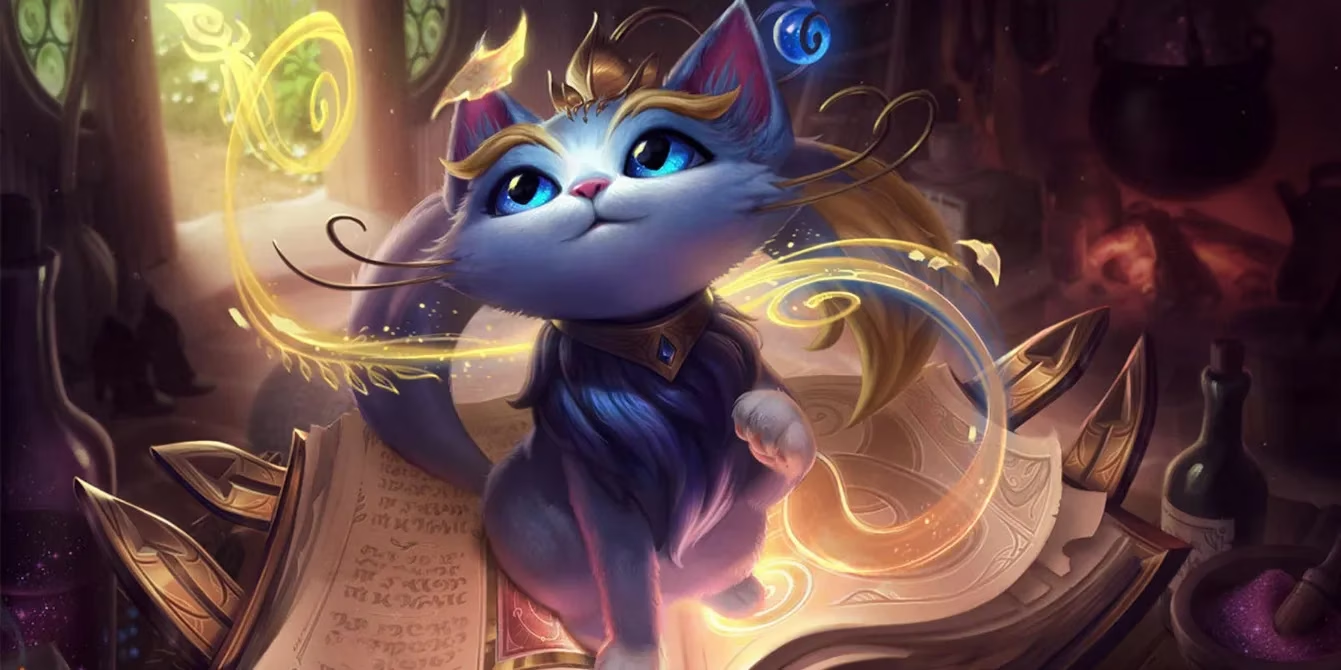
As we approach the 2026 competitive season, I can't help but reflect on the long and winding journey of one of League of Legends' most divisive champions: Yuumi. The Magical Cat, once a specter haunting every draft phase at the highest levels of play, has undergone a transformation so profound it feels like watching a caterpillar emerge from its chrysalis as a creature of an entirely different order. Riot Games' multi-year mission to rework Yuumi has finally reached its conclusion, and the results are reshaping how we think about champion design, accessibility, and the delicate ecosystem of competitive balance. The story of Yuumi is a testament to the developer's willingness to admit when a core fantasy, while charming, has fundamentally broken the game's social and strategic contracts. Her journey from a 95% pick/ban terror at the 2022 World Championship to her current state is a masterclass in iterative, player-focused design.
The Genesis of a Problem: An Unshakeable Parasite
The core issue, as Riot lead designer Matt Leung-Harrison famously outlined, was Yuumi's inherent design paradox. Her signature Attach (W) ability made her untargetable, creating a gameplay loop that was fundamentally different from any other champion. At the professional level, this wasn't just a quirk; it was a weapon. Skilled players could turn Yuumi into an unkillable stat-stick, permanently amplifying a hyper-carry while being immune to retaliation. The data was damning: during the 2022 Worlds, she boasted a 100% win rate whenever she slipped through bans. She became the ultimate force multiplier, a symbiotic leech on the meta that warped team compositions and strategies around her mere presence. Balancing her for both a novice player learning the ropes and a world-class bot lane duo proved to be an impossible task. She was either oppressive or useless, with no healthy middle ground.
The Phased Solution: Nerfs, Vision, and a New Identity
Riot's approach was deliberate and phased. The immediate response in the patches following the 2022 debacle was a series of targeted nerfs aimed squarely at her professional potency. These were stopgap measures, described by Leung-Harrison as "an immediate solution" to lower her ceiling while the team worked on a more holistic rework. The long-term vision was clear: reforge Yuumi from a pro-play menace into a dedicated learning tool for new players. The goal was to shift her power budget away from amplifying an already powerful ally and toward rewarding her own active participation and skill expression. The philosophical pivot was significant. Riot decided to fully embrace the fantasy of Yuumi as a loyal lane companion, a champion designed to "help them learn spell usage & nuances of positioning," rather than trying to make her work at all levels of play.
The 2026 Rework: A New Pact with Players
The rework that culminated in the 2025 preseason and is now the standard in 206 has fundamentally altered Yuumi's gameplay. The changes are built on three pillars designed to eliminate frustration and encourage healthier patterns:
-
Counterplay During Attach: Yuumi is no longer an inviolable sanctuary. Opponents now have clear windows of opportunity. Her Attach now has a resource bar that depletes over time while attached and is only refilled by landing her Prowling Projectile (Q) on enemy champions or by being unattached and auto-attacking. This turns her presence into a managed resource, not a permanent state.
-
Rewarding the Cat, Not Just the Carry: Yuumi's power is now directly tied to her personal performance. Her Zoomies (E) heal and shield scales more significantly with her own Ability Power and ranks, and landing a fully charged Q on an enemy champion grants her partner a brief, decaying movement speed boost and refunds a portion of her Attach resource. This creates a compelling mini-game for the Yuumi player.
-
The Best Friend System: The most innovative change is the "Best Friend" mechanic. When Yuumi attaches to an ally for an extended period in the early game (achieved by scoring takedowns or assisting that ally), they become linked. Yuumi's abilities are significantly more potent when attached to her Best Friend, incentivizing her to stay with her lane partner rather than abandoning them at first opportunity to hop onto the jungler like a remora fish latching onto a shark.
Impact and Reception: A Healthier Ecosystem
The results, as of the 2026 season, have been transformative.
| Aspect | Pre-Rework (2022) | Post-Rework (2026) |
|---|---|---|
| Pro-Play Presence | ~95% Pick/Ban, Must-Pick | <5% Pick Rate, Niche Counter-Pick |
| Solo Queue Win Rate (All Ranks) | Highly Volatile (~48-52%) | Stable at ~50-51% |
| New Player Retention | Low (Frustrating for ADC partners) | High (Clear learning path) |
| Opponent Frustration | Extremely High (No counterplay) | Moderately Low (Clear windows) |
Yuumi has found her niche. In professional play, she's a rare sight, reserved for specific, team-comp-dependent strategies. Her era of dictating the meta is over. In solo queue, especially in lower and middle elos, she thrives as a forgiving enchanter that teaches support fundamentals. The rework has successfully excised her from high-level play without making her obsolete. For the community, the change has been largely positive. While some dedicated high-elo Yuumi mains mourned the loss of her old, high-skill expression kit, the overall reduction in frustration has been a net gain for the game's social health. No longer is her pick met with audible groans from her own team or the enemy. She's now a welcoming lighthouse for new Summoners, guiding them through the game's initial complexities, rather than a rogue satellite permanently orbiting the strongest player on the map, warping the game's gravity around them.
Looking Forward: The Legacy of the Rework
The Yuumi rework stands as one of Riot's most significant and successful balance interventions. It proved that the studio is willing to make hard choices, even if it means deliberately lowering a champion's competitive ceiling for the greater health of the game. It established a new template for designing accessible champions that don't sacrifice depth for simplicity. The "Best Friend" system, in particular, is a brilliant piece of design that reinforces positive player behavior—sticking with your partner. As we move deeper into 2026, Yuumi's story is no longer one of imbalance and frustration, but of successful reinvention. She serves her intended purpose beautifully, acting as a gentle introduction to League of Legends' vast world, and that, in the end, is a victory for players of all skill levels.
Comments