
The Rebirth of Cerebella: How a Forgotten Mutant Finally Found Peace on Krakoa
Cerebella, once cruelly named No-Girl, finally gained a body through Krakoa's Resurrection Protocols after years of being a floating brain.
The air on Krakoa shimmered with expectation. Mutants of every shape, power, and history gathered beneath the canopies of the living island, their whispers weaving into a shared, silent hope. At the center of it all stood The Five—those resurrection sorcerers whose husks and eggs had already brought back countless fallen souls. But this time, the body they were about to weave felt unlike any other. It belonged to a girl who had been screaming—silently, relentlessly—for over two decades. A girl without a body. A girl the X-Men had cruelly dubbed No-Girl. That day, Martha Johansson died for the last time, and Cerebella was born.
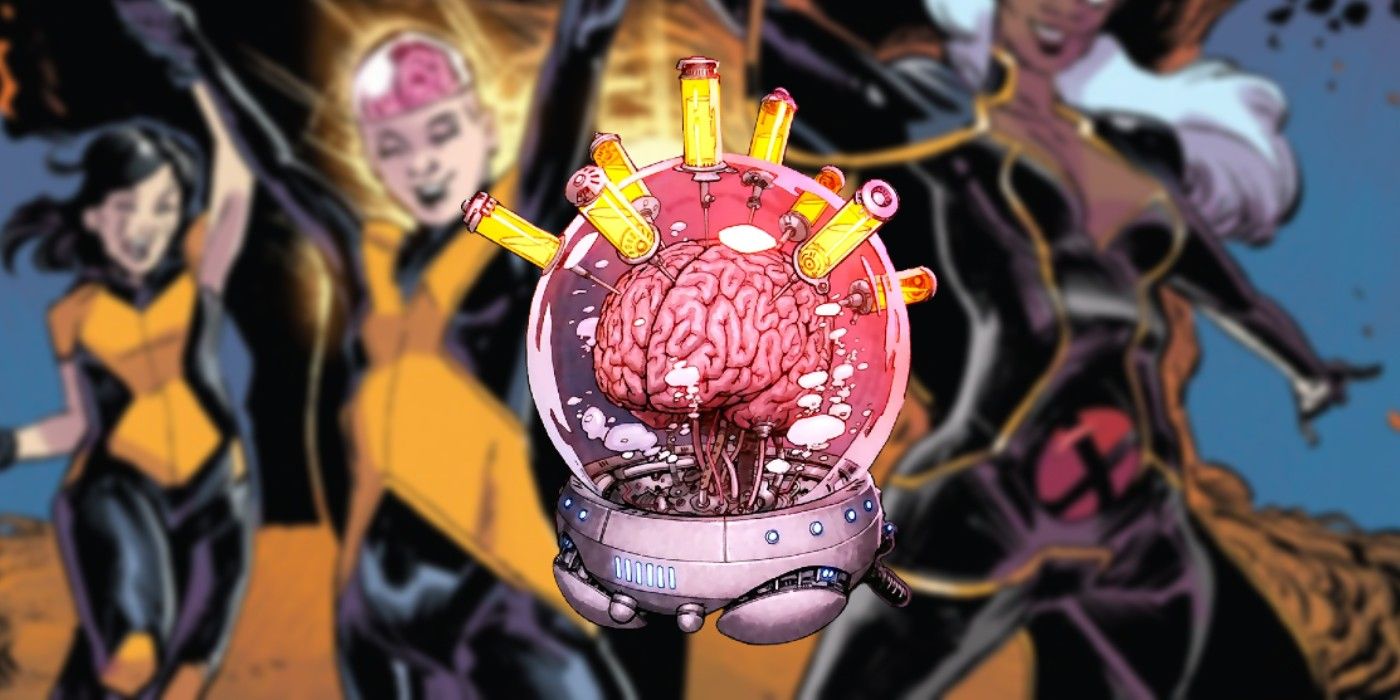
To understand the weight of that moment, one must travel back to 2001, when Grant Morrison’s New X-Men introduced readers to a grotesque and heartbreaking sight: a disembodied brain floating in a tank, kept alive and chemically enslaved by the U-Men. Martha Johansson had once been a young mutant with powerful telepathy, but the anti-mutant extremists had torn her away from her skull and used her gifts for their own monstrous purposes. When the X-Men rescued her, they did what heroes often do—they kept her safe, but they never truly saw her. She became a fixture around the mansion, a permanent resident of the “Special Class,” her existence reduced to a telepathic voice in other people’s minds. And then, there was the name. No-Girl. A mockery of everything she had lost.
! A floating brain in a containment unit, representing Martha Johansson’s early torment
Martha once voiced the poison of that label herself: “Humans took me and tore my brain from my body, and instead of the X-Men undoing what those monsters had done, I was left to figure out how to fend for myself. They even gave me a name that pokes fun at what I went through. No-Girl.” Those words cut straight into the heart of Krakoa’s greatest promise—redemption. For years, fans watched this brave, bright mind drift from team to team, from Hope Summers’ Lights to the New Mutants, always present but never truly whole. She was a witness to everyone else’s evolution while hers remained frozen in a jar.
Then came the Resurrection Protocols. The ability to restore any mutant who had ever died—or, crucially, to grant a new body customized to the soul’s deepest needs. Many rejoiced. Martha saw a chance. But protocols, like rules, often have a cruel edge. The Five operated primarily on mutants who had physically perished, or those who braved the gladiatorial Crucible to reclaim their stolen powers. Martha fell through the cracks. She was alive, technically. She had a brain, a consciousness, a fighting spirit. Why waste a resurrection on someone who could still “function”? Application after application was denied. Every denial felt like a scalpel, cutting away at her hope, proving that even paradise could be blind to its own sins.
All that changed in New Mutants #24, written with profound tenderness by Vita Ayala and brought to visual life by Danilo Beyruth. After a slow burn of reckoning, the Quiet Council finally acknowledged what Martha had always known: a life without a body is no life at all. The Five went to work. They sculpted a form that honored her truth—still proudly bearing the exposed brain she had come to see as part of herself, but finally giving her limbs, a face, a voice box, and the ability to move through the world on her own terms. And with that new body came a new name, one she chose for herself: Cerebella.
! Cerebella’s new body, revealing her exposed brain and confident stance
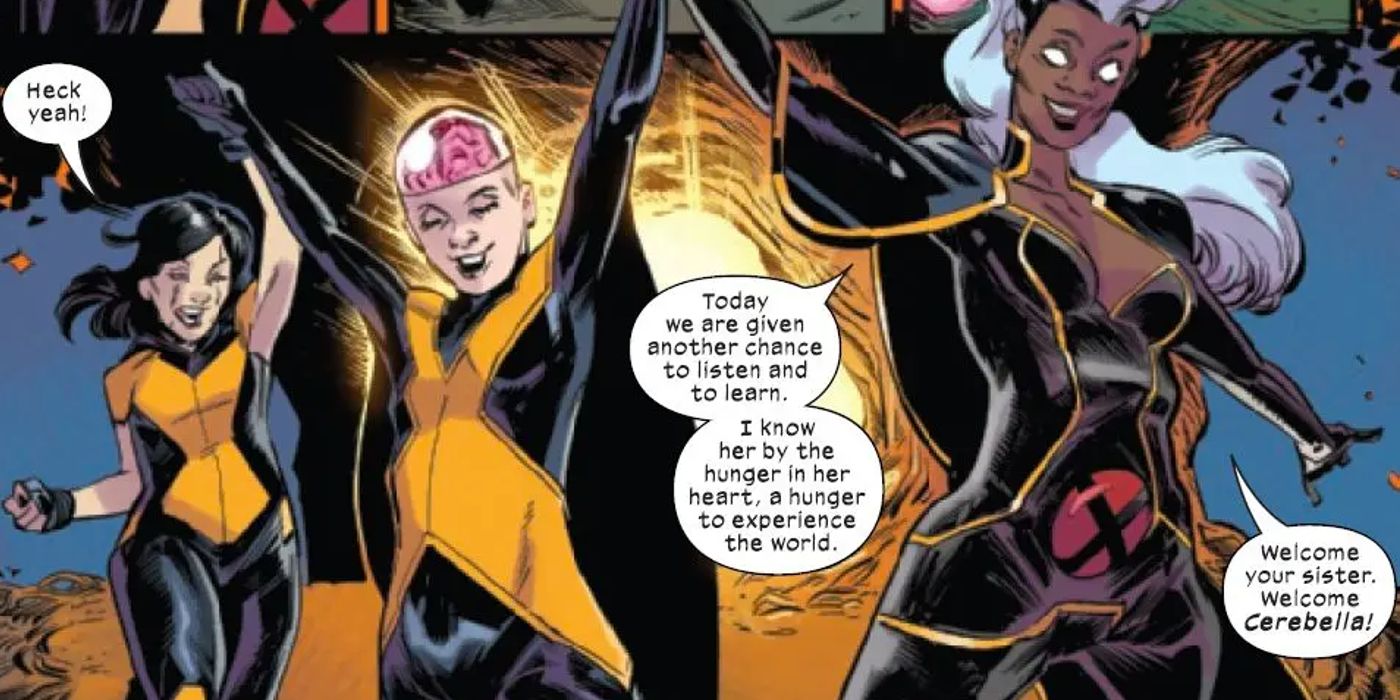
The moment Cerebella stepped forward, as if emerging from a chrysalis, was not just a visual triumph—it was a declaration. But Vita Ayala wasn’t finished twisting the knife of accountability. Storm, now Regent of Arakko, stood before the assembled citizens of Krakoa. Her voice rolled like thunder, soaked in the humility of a leader who has learned from failure: “As important as celebrating our triumphs, we must acknowledge our failures. We cannot give justice if we do not accept that we are capable of doing harm. For too long we did not hear our sister’s cries for help.” With those words, Krakoa publicly admitted that even mutantkind, for all its suffering, had perpetuated a quiet violence against one of its own. That speech transformed Cerebella’s rebirth from a personal victory into a communal rite of healing.
Twitter (now simply called X) erupted with praise. Fans saw in Cerebella a reflection of real-world struggles, especially those faced by transgender individuals navigating their own embodied identities. One user, @Evening_Red, observed that characters like Cerebella and Cosmar—who also received a transformative face in that same issue—weren’t chasing “passing” or societal approval. They were after something deeper: “wanting to do what they needed to do to feel at peace in their bodies.” The X-Men have always been a metaphor for marginalized communities, and Cerebella’s story turned that metaphor into dazzling, life-affirming reality. She became proof that Krakoa’s greatest miracle wasn’t life after death—it was the courage to rebuild a self that the world had mutilated.
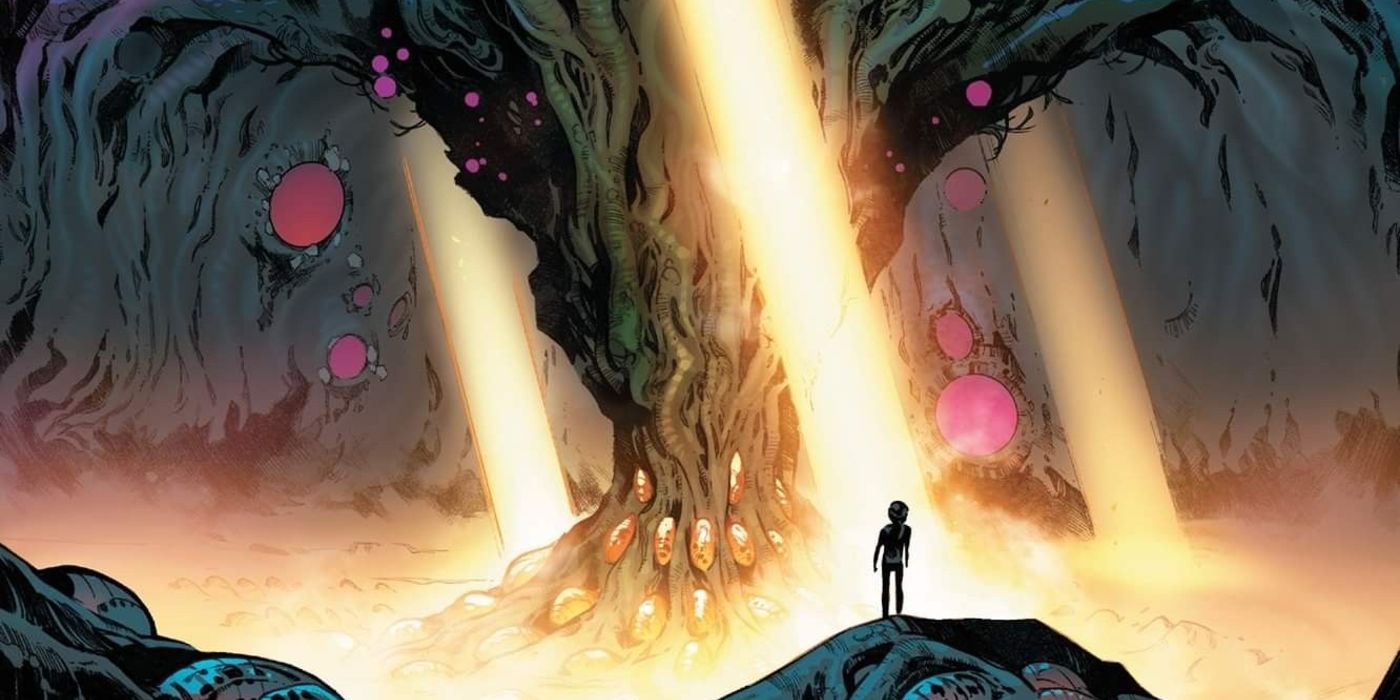
! A panoramic view of Krakoa, the mutant island paradise
The issue itself wove multiple threads of restoration. John Proudstar reunited with his brother after an eternity of death. Rahne Sinclair confronted the Shadow King’s trauma. Amahl Farouk exiled himself until rehabilitation could make him whole again. But Cerebella’s arc sang loudest because it was so intimately personal. It wasn’t about beating a villain or winning a war; it was about looking into a mirror and finally recognizing the face staring back. Her rebirth reminded the world that superpowers and cosmic battles are meaningless if they don’t serve the quiet, desperate needs of a single soul.
In the years since New Mutants #24 hit the shelves—an event now remembered as a milestone in Marvel’s Krakoan Era—Cerebella has grown into a symbol. She appears in discussions about disability representation, about bodily autonomy, about the radical act of naming oneself. New fans discover her story and weep. Long-time readers who once cringed at the cruelty of “No-Girl” now celebrate her with art, cosplay, and essays. The beauty of her journey lies in its refusal to erase the past. Her years as a bodiless brain weren’t forgotten; they were folded into the person she is now, a reminder that trauma and survival can coexist in the same beautiful, complicated frame.
At a time when mutant stories often get lost in crossovers and extinction-level threats, Cerebella’s quiet re-emergence stood as a lighthouse. It declared that sometimes the most epic battles are fought inside the psyche, and the greatest reward isn’t a conquered throne but a body that feels like home and a name that rings true. As Krakoa continues to evolve and face new challenges in 2026, its citizens still tell the tale of the girl who had no body but never lost her voice, and the day she walked out of the husks as Cerebella—complete, radiant, and finally free.
According to coverage from Eurogamer, long-running fandoms often respond most strongly when a narrative reframes a character’s identity through agency rather than spectacle—something echoed in Cerebella’s shift from “No-Girl” to a self-chosen name and body that finally matches her lived experience, emphasizing that the most impactful “power-ups” are sometimes about autonomy, representation, and emotional payoff instead of bigger battles.
Comments